



UPCOMING EVENTS
Grounded Sound Journeys
with Terrie Weaver & Silvy Franco
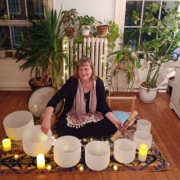
October 9th & 16th with Kava
+++++++++++++
Free community film screening: Numen, the Healing Power of Plants
Saturday October 17th
6:00 – 7:00 pm
+++++++++++++
3-Day Immersion: Reading the Body Immersion
with Margi Flint
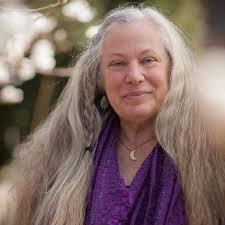
October 23rd-25th : 10am-4pm
+++++++++++++
Medicine-Making Circles

Fire Cider & Herbal Oxymels
October 24 ~ 1-3:30
Get ready for the turn of the seasons with an immune supporting and warming batch of fire cider with locally harvested herbs, roots and warming spices. We will use locally harvested ingredients and spend some time in collective community crafting as you prepare your own batch of fire cider to have on hand as winter nears.
+++++++++++++
Stardust Market
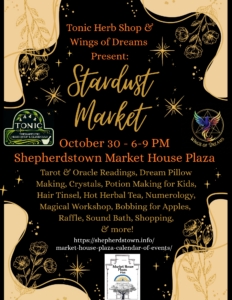
Friday, October 30th
6-9 pm
Market Square downtown Shepherdstown
Join Tonic & On the Wings of Dreams for a magical evening of autumn fun featuring mulled cider, crystal wrapping, dream pillow-making, tarot & oracle card readings, hair tinsel, numerology, bobbing for apples, potion making for kids, sound healing and more!
VIOLET
/in Herb of the Month /by Ashley Davis(Viola odorata)
A common herb found in backyards, gardens, fields and forests, this lowly plant is often overlooked as medicinal, but don’t let its small stature or quiet disposition deceive you. It’s full of nutrients and makes a lovely spring potherb, tea, and is a soothing, anti-inflammatory & detoxifying tonic.
Family: Violaceae
Actions: vulnerary, lymphatic, alterative, emollient, expectorant, mild diuretic & mild laxative
Parts Used: Leaf & Flower
Energetics: cooling, moistening
Description: The sweet-scented Violet appears at the end of March and has finished blooming by the end of May. The familiar heart-shaped leaves are slightly downy, especially beneath, and grow from stalks that rise from a creeping rhizome. The young leaves are curled up on the edges, rolled up from each side into the middle of the leaf into two tight coils. The flower-stalks arise from the axils of the leaves and bear single flowers. The dark purple flowers bear five sepals extended at their bases, and five unequal petals.
There is a remarkable botanical curiosity in the structure of the Violet: it produces flowers both in the spring and in autumn, but the flowers are different. In spring they are fully formed, as described, and sweet-scented, but they are mostly barren and produce no seed, while in autumn, they are very small and insignificant, hidden away amongst the leaves, with no petals and no scent, and produce abundance of seed.
The Violet also propagates itself, also, in another way by throwing out scions, or runners, from the main plant each summer after flowering, and these in turn send out roots and become new plants, a process that renders it independent of seed. (Grieve)
Uses: Violet flowers are rich in vitamin C and the leaves are packed with Vitamin A (carotene). The leaves affect the nerves, lungs, immune & reproductive systems, with a special affinity for the breasts. Violet supports lymphatic circulation and mildly enhances bowel, liver & kidney function. Violet has a long history of being used in cancer treatment, in combination with other therapies. On its own, violet has been known to help dissolve tumors, cysts and some cancers, especially in the breasts. It essentially dissolves hard masses while relieving congestion of the lymphatic glands.
Indications: Breast congestion, cystic breasts, lymphatic congestion, dry or spasmodic cough, red, itchy & inflamed skin conditions. Hippocrates recommended violet for headaches, hangovers, bad eyesight, and excess of bile. Pliny said they induced sleep, strengthened the heart muscle & calmed anger. They have been used in Arabic medicine for constipation, tonsillitis and insomnia.
Cautions: no side effects or drug interactions found.
Preparations: eat the leaves and flowers in a spring salad, use as an infused oil for breast massage, as a salve or poultice for topical relief of irritations to the skin, as an infusion for a nourishing & detoxifying tonic, as a tincture for its alterative action, or as a syrup for coughs.
Dose: Tincture: 1-2 ml 3 x a day; as an infusion, use 1 cup of dried herb to 1 quart water. Steep 4-8 hours, then strain. Drink 1-3 cups a day.
Homeopathic Use: for breathlessness & spasmodic coughs, whooping cough and breathing problems associated with anxiety. It is also for headaches with burning of the forehead & pain above the eyebrows and vertigo. A Violet person easily gets tense & over-excited. It particularly suits thin, nervous girls.
Flower Essence: for profound shyness; suited for people who are delicate, sensitive and timid. Violet engenders a sense of warmth & openness.
Folklore: Violet has been grown commercially since Greek times. The blooms were sold in Athenian street markets. The Romans adored the flowers and used them to adorn the heads of poets, civic leaders and other officials. Both cultures wore garlands of violet to prevent drunkenness. It was also used in love potions.
References:
This information is for educational purposes only and is not intended to diagnose, treat, or cure any disease.