




UPCOMING EVENTS
Grounded Sound Journeys
with Terrie Weaver & Silvy Franco

October 9th & 16th with Kava
+++++++++++++
Free community film screening: Numen, the Healing Power of Plants
Saturday October 17th
6:00 – 7:00 pm
+++++++++++++
3-Day Immersion: Reading the Body Immersion
with Margi Flint

October 23rd-25th : 10am-4pm
+++++++++++++
Medicine-Making Circles

Fire Cider & Herbal Oxymels
October 24 ~ 1-3:30
Get ready for the turn of the seasons with an immune supporting and warming batch of fire cider with locally harvested herbs, roots and warming spices. We will use locally harvested ingredients and spend some time in collective community crafting as you prepare your own batch of fire cider to have on hand as winter nears.
+++++++++++++
Stardust Market
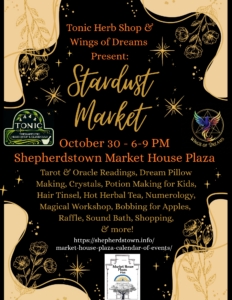
Friday, October 30th
6-9 pm
Market Square downtown Shepherdstown
Join Tonic & On the Wings of Dreams for a magical evening of autumn fun featuring mulled cider, crystal wrapping, dream pillow-making, tarot & oracle card readings, hair tinsel, numerology, bobbing for apples, potion making for kids, sound healing and more!
Skullcap
/in Herb of the Month, Uncategorized /by Ashley DavisSkullcap feels like it’s gently coating your skull with a protective layer that drowns out the background noise and quiets down the stimuli that can cause us to feel overwhelmed.
Another name for skullcap is ‘Mad Dog Weed’ because it used to be used as a remedy for rabies, which is an extreme example of cerebral excitation (symptoms include insomnia, anxiety, confusion, agitation & hallucinations). Read on to learn more about the benefits of skullcap:
Botanical Name: Scutellaria lateriflora
Common Names: Skullcap, European Skullcap, Blisswort, Mad Dog Weed, Mother’s Little Helper
Family: Lamiaceae (mint family)
Parts used: Aerial portions
Energetics and Tastes: bitter, cooling, drying.
Actions and Properties: Neurotrophorestorative (restores function to the nervous system), anxiolytic (reduces anxiety), nerve tonic, bitter tonic, antispasmodic, sedative, slightly astringent, analgesic, anticonvulsive, anti-seizure.
Meridians/Organs/Tissue States: Nerves, Small Intestines, Stomach
Constituents: Flavonoid glycosides (including scutellarin, baicalin and baicalein), amino acids, iridoids, volatile oil, waxes and diterpenes.
Description: It grows from 60-80 centimeters in height and produces purple flowers that grow up the side of one stem from the leaf axils. The Skullcaps (Scutellaria spp.) have a distinctive feature making them easier to identify. There is a distinctive cap (generally called a ‘protuberance’) on the upper side of the calyx. This part has given them both their genus and common name. A ‘scute’ is a plate or scales, similar to those found on lizard, alluding to the protuberance, as is the name skullcap (7 Song). Scutella, meaning “little dish” or scutellum meaning “little shield” both describe the shape of the calyx. Lateriflora means that the flowers on the racemes are turned to one side. In the 1700s the Genus was Cassida, which meant “helmet,” referring to the upper part of the calyx.
Habitat: Native to North America and Europe, Scutellaria lateriflora is a perennial herb that likes to grow in wet places such as near marshes, streams, and other damp areas. Different species of skullcap grow across North America. While these plants aren’t explicitly endangered, they could easily be over-harvested since they don’t grow in profusion. It prefers full-part sun and moist soil.
Solubility: Soluble in alcohol and water. Dried skullcap is useful as a tea. Skullcap extract is best tinctured when fresh. When making a fresh plant tincture, it is recommended to use 95% alcohol at a 1:2 ratio.
Indications: Acute and chronic stress, panic attacks, anxiety, PMS, mood swings, irritability, menstrual cramps, pain, muscle spasms, insomnia, pain attacks, heart palpitations, seizures, twitching, teething, TMJ pain, restless legs, muscular tension, headache, fever, rabies, mania, hysteria, delirium, epilepsy, Alzheimer’s, Parkinson’s, Huntington’s, arthritis, cancer, inflammatory bowel conditions, ADHD.
Skullcap is a wonderful plant to calm anxiety, panic, worry and irritability without overly sedating you or making you overly drowsy. It helps to put some distance between you had your stressors by calming you down and nourishing your nervous system. When taken long term, it nourishes and rejuvenates the nervous system. For overstimulation, hyperactivity and re-activity, heat and irritation.
Skullcap can also be helpful for people going through withdrawal. It keeps the nervous system on a steady keep and reduces the symptoms of withdrawal and combines well with fresh milky oats tincture for this purpose.
Herbalist Kiva Rose uses skullcap “for nerves so frayed they’re about to snap, resulting in a very emotionally labile and reactive person. These people have a tendency to flip out over (seemingly) nothing. They feel as if every sound, touch and bit of light is personally attacking them. They are exhausted on a deep level and need nourishment in the form of rest, nutrient dense food and nervous system restoratives.” (Kiva Rose). Herbalist David Winston uses skullcap for ADHD and the associated irritability, repetitive movements, oversensitivity to external stimuli and outbursts of anger.
And herbalist Seven Song says “I see it most useful for people who constantly need to take charge. They make constant contingency plans and feel personally insulted when things don’t go their way. They may have insomnia and cannot initially fall asleep due to thinking about all the things they could have done differently that day. They might worry about their performance about everything (‘was the dinner okay?’) and are expert at criticizing themselves, and others.
One other place I find skullcap helpful, is for people who have an emotional attachment to their injury. This is common. When the person thinks about how they sprained their ankle or got stung, there is an upsetting emotional quality to it. With this type of person you may see them blaming themselves for the injury (‘I knew I shouldn’t have run that trail’) Skullcap may help relieve the physical pain and some of the emotional pressure.” (7 Song)
Its antispasmodic properties make it helpful for relaxing muscular tension (both smooth & skeletal muscles), and involuntary twitching, spasm and convulsions, including restless leg syndrome and menstrual cramps. It can even relieve tremors and seizures and palsies.
For sleep, it is especially helpful for sleeplessness due to excessive mental chatter, ruminating thought patterns, and muscle tension. It does not sedate you to the point of drowsiness during the day, but can be very helpful for relaxing the mind and body enough to allow the tiredness to be felt at night and override the anxiety and overstimulation that is preventing sleep.
Combinations:
Preparation and Dosage:
As a trophorestorative/nervous system tonic for chronic stress, skullcap is best used in significant doses over long periods of time, and it can be very effective when used correctly.
Contraindications: Despite some claims that skullcap is not safe to be used during pregnancy due to its emmenagogue properties, traditional texts say that skullcap is very safe to use, even in high doses, for the young and old and in pregnancy and breastfeeding. In fact it was widely used by the Eclectic physicians of the 18th and 19th centuries for various female disorders in both pregnant and non-pregnant women.
History/Folklore/Mythology: Skullcap was very popular with the general public in the time before pharmaceutical tranquilizers. In the early 20th century when sedative drugs came on to the market the medical establishment went to lengths to discredit Skullcap by using its rather exaggerated claim to be able to cure the madness of rabies as the rope to hang it by — thus it fell from favour. In 1772 skullcap was introduced into the medical field as a prophylactic and treatment for rabies after Dr. Lawrence Van Derveer discovered its “powers” to cure mad-dog disease. The name “MadDog Skullcap” was derived from this alleged cure associated with the plant. Testimonies abound in the early 1800s confirming skullcap’s use for rabies and brought a reputation to Dr. Lawrence Van Derveer as the doctor who cured rabies.
Skullcap is an indigenous North American species and was utilized by the Cherokee and Iroquois tribes. The Cherokees made a decoction consisting of “S. lateriflora, S. elliptica, Hypericum spp. and Stylosanthes spp. [pencil flower] to promote suppressed menstruation” and as a “wash to counteract the ill effects of eating food prepared by a woman in the menstrual condition, or when such a woman by chance comes into a sick room or house under taboo”. A decoction of the root was used for diarrhea, breast pains, and the expelling of afterbirth. The Cherokee also created a root compound from the herb to aid the kidney. The Iroquois made an infusion from powdering the roots for the prevention of smallpox and for cleaning the throat.
References: